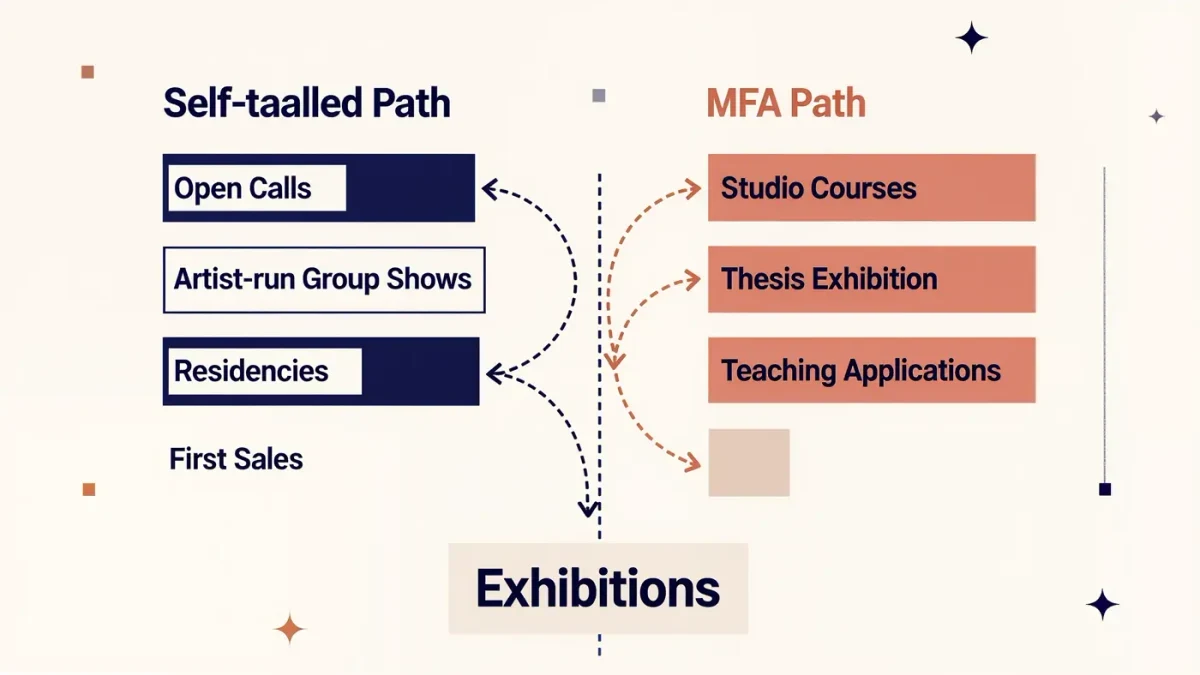
No gallery in New York asks for a diploma before it looks at the work. Self-taught artists build careers through open calls, artist-run group shows, residencies, and programs like the Bronx Museum's Artists in the Marketplace, a decades-running seminar that ends in a museum group exhibition. The MFA opens certain doors. It opens almost none of them by itself.
The honest difference between the paths is cost. Graduate tuition runs far beyond what most studios earn back, and a widely cited 2014 study by the artist collective BFAMFAPhD found that only a small minority of arts graduates make their living primarily as artists. Debt changes what a studio can afford to risk. Art Real NY publishes information, not career or financial advice.
Do you need an MFA to show in New York?
No, and the proof hangs on museum walls. Jean-Michel Basquiat never finished an art degree; he turned SAMO graffiti and downtown drawings into a solo debut at a Manhattan gallery in 1981. Curators and dealers weigh exhibitions, the work itself, and who vouches for it. A degree is a footnote on a resume, not a ticket inside.
What the degree does signal is institutional vetting — somebody already critiqued this person weekly for two years. Self-taught artists replace that signal with visible momentum: a steady exhibition record, a coherent body of work, and other artists saying the name out loud. It takes longer. It is slower to start and impossible to fake, which is exactly why it holds up.
The places that matter most to emerging artists in Brooklyn and Queens — artist-run spaces, collective studios, storefront project rooms — rarely ask about credentials at all. They ask whether the work is good and whether the person shows up when they say they will.
What does an MFA actually buy you?
Two years of protected studio time, access to equipment most graduates never afford afterward, sustained critique from working artists, and a cohort that becomes the professional network of the next thirty years. It also satisfies the conventional requirement for teaching at the college level, where the MFA serves as the terminal degree.
What it does not buy: a gallery, sales, taste, or discipline. Plenty of MFAs graduate into the same open calls as everyone else, and plenty of self-taught painters outwork them. The degree is an accelerant on some careers and dead weight on others. Its value depends almost entirely on what the person brings in and how the debt gets carried out.
There is also a temperament question hiding inside the credential question. Some artists do their best work under external pressure — deadlines, critiques, a building full of peers — and the MFA manufactures that pressure on schedule. Others find the same pressure in a shared studio, a group-show deadline, or a day job that ends at five and leaves the nights ferociously clear. Knowing which temperament applies matters more than any brochure.
Which non-degree programs do similar work?
New York stocks serious alternatives to the studio-art degree: intensive non-degree programs, museum seminars, summer residencies, and continuing-education courses that grant critique, community, and facilities without two years of tuition. Each has its own emphasis, and none requires a prior credential to apply.
- The Bronx Museum's Artists in the Marketplace seminar, culminating in a museum group show.
- The Whitney's Independent Study Program, a storied non-degree year of seminars and critique.
- Skowhegan, the Maine summer residency founded in 1946, which asks for no degree.
- Continuing-education studio courses at schools like SVA, Pratt, and Parsons, priced per class.
- Independent critique collectives, where artists meet monthly to read each other's work honestly.
Stacked together, these can approximate the MFA's core benefits — critique, community, equipment, deadlines — at a fraction of the price, spread over years rather than compressed into two. The main thing they cannot replicate is the accredited credential for college teaching.
Related stories: How Artists Get Into Group Shows · How Artist Residencies in New York Work.
How do self-taught artists build a network from zero?
The same way every artist does, minus the head start: show up, repeatedly, in rooms where curators and peers already gather. Attend openings in Bushwick and Ridgewood, volunteer with nonprofit spaces, apply to every open call that fits, join a studio building, and stay reliable for five years. Networks are built on familiarity, and familiarity is built on frequency.
One studio visit from a curious curator matters more than a hundred LinkedIn connections, and studio visits come to artists who are visible — in group shows, in volunteer crews, in each other's studios. The self-taught route trades money for time. Anyone choosing it should budget both honestly.
Volunteering deserves its own sentence, because it is the closest thing the art world has to a side door. Painting walls for a nonprofit before an opening, sitting a desk during a benefit, helping install a charity auction — the work is real, the gratitude is specific, and the people met are the ones who later forward open calls and write recommendation letters. Nobody remembers who arrived with a degree. Everybody remembers who stayed to sweep.
How do the finances of each path compare?
Roughly: public programs for New York State residents, such as the MFA studios at CUNY schools like Hunter, Brooklyn College, and Queens College, cost a fraction of private tuition; private programs cost several times more and often mean five-figure loans. Loan payments then compete with studio rent and materials for years. That arithmetic shapes what a practice can risk.
The self-taught artist pays differently — in nights, in day-job fatigue, in workshop fees — but keeps the upside of owing nothing. Neither path guarantees income. Art markets reward a small number of practitioners regardless of credentials, and the strongest hedge either way is cheap rent, flexible work, and a habit of finishing things.
Frequently asked questions
Is an MFA worth the money for a working artist?
It depends on what gets bought. For artists who need forced structure, facilities, critique, and a concentrated network, the cost can pay out over a decade. For those already showing steadily and making work without institutional pressure, the same money often goes further as rent, materials, and time. Run the debt arithmetic first.
Can you teach college art without an MFA?
Rarely. Full-time studio-teaching positions at colleges and universities conventionally require the MFA as the terminal degree, and listings repeat the requirement. Adjunct and continuing-education courses are more flexible, and some accomplished self-taught artists are hired for them. Teaching younger students or community programs carries no such gate.
Which New York programs accept self-taught artists?
Most non-degree programs judge portfolios, not transcripts. The Bronx Museum's AIM seminar, Skowhegan's summer residency, the Whitney's Independent Study Program, and scores of artist-run open calls across Brooklyn and Queens all admit on the strength of the work. Read each program's eligibility page before applying.
Do collectors care whether an artist has an MFA?
Almost never at the point of purchase. Collectors buy the object, the exhibition history, and the story the gallery tells about the work. A degree occasionally reassures a cautious buyer, and biographies mention schools, but the CV lines that move sales are exhibitions, reviews, and collections — all of which are open to the self-taught.